

Operations, Logistics & Kaizen Philosophy
- Less rework, fewer incidents, more predictability.
- Live standards so performance doesn't depend on 'key people'.
- Criteria-based logistics and stock: seen & controlled.
End-to-End Flow Map
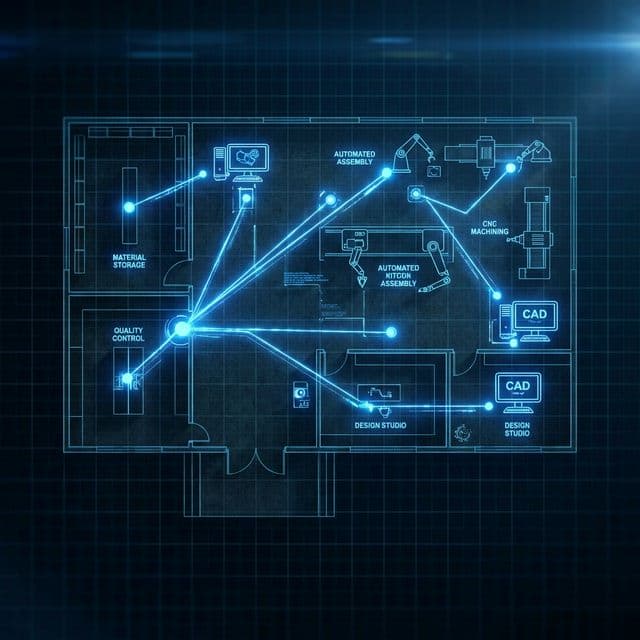
In the furniture and home sector, margin is lost between stages: from design and purchasing to the workshop and installation at the client's home. Improvement doesn't start with 'more effort', but with absolute flow visibility, detecting control points and establishing clear handoff rules between departments.
Actual cycle time
From order to final installation.
Queues and waiting
Static material that adds no value.
Rework and repetitions
The cancer of operational profitability.
Incidents by stage
Identify the source, not just the symptom.
Lead time compliance
Reliability of the commercial promise.
Cost of non-quality
What you lose by repairing errors.
Metodología 5S
Kaizen: habits that sustain the system
Kaizen Culture and Live SOPs: Practical standardization. I assist in moving from 'this is how Juan does it' to a company standard. I establish a discipline of continuous improvement where the team identifies and solves root problems without heavy bureaucracy.
10 min daily stand-up
Tactical synchronization.
Weekly bottleneck review
Unblocking critical flow.
Light 5S audit
Maintain order without effort.
Root cause closure
Don't patch, solve forever.
Logistics & Stock: protected margin
Advanced Logistics and Stock Management: I design effective inventory policies. I optimize your warehouse with 5S methodology (order and signaling) because margin is lost searching for parts or managing unforeseen stockouts.
Lead time compliance
Delivery reliability.
Right first time
Zero incoming incidents.
Variability
Stability in supply.
Incident response
Resolution speed.
Deliverables
Frequently Asked Questions (Operations & Kaizen)
Q1.Is Kaizen only for large factories?
No. Kaizen is a philosophy of eliminating waste. It works just as well in a 5-person workshop as it does in an industrial plant, because the focus is on standards and flow.
Q2.How long until we see results?
Visual changes (5S) are immediate. The culture of continuous improvement and incident reduction typically stabilizes over 3 months of discipline.
Q3.Do I need to buy expensive software?
Not necessarily. My approach is 'process before technology'. Often, a visual board and clear video SOPs via QR are more effective than complex software.
Q4.How does Kaizen help my logistics?
By organizing the warehouse by frequency of use and establishing clear reorder points. Less time searching means more time installing.
Q5.What if my team resists change?
Video SOPs and hands-on training reduce friction. When they see the system making their jobs easier and reducing stress, most join in the Ownership.
Q6.Do you do the physical implementation?
I collaborate with your team on zone design and training, but real Ownership comes from your people executing the change guided by my method.