
# Fragmented System: Isolated Tools That Sabotage Efficiency
When every department speaks a different language, you pay in invisible hours, errors, and frustrated customers: signals to detect fragmentation before it becomes a structural cost.
There is a scene I see repeated in companies that, on paper, are "digitized".
A customer calls to ask about the status of their issue. The person attending says: "One second, let me check."
That "second" turns into three minutes of silence.
What happens behind the scenes (which the customer intuits but does not see) is a frantic dance: Alt-Tab to exit the CRM, open the ERP to see if possible spare parts went out, open email to find the technician's confirmation, open a shared spreadsheet—which someone has locked—to see if the visit was scheduled.
Four tools. Four partial truths. No immediate answer.

In the end, the answer is vague: "We are handling it, we will tell you something soon."
The customer hangs up with the feeling that no one is in control. And they are right.
This is not a problem of "lack of software". Sometimes it is, precisely, an excess of disconnected software. It is what I call the fragmented system: an accidental architecture where each department bought its own solution to "go faster", creating an archipelago of data that makes the company, as a whole, go much slower.
## The Invisible Cost of Information Islands
When I ask operations directors about their biggest pains, they usually mention things like "staff shortage" or "supplier delays". Rarely do they tell me: "my people spend 20% of their time copying data from one screen to another".
But that is exactly what happens.
Fragmentation has a brutal operational cost that does not appear on any technology provider's invoice:
### 1. The Reconciliation Tax
If Sales uses Salesforce, Operations uses SAP, and Aftersales uses Zendesk (or an Excel sheet), and they don't talk in real time, someone has to be the bridge.
That bridge is people. Valuable people dedicated to exporting CSVs, re-typing orders, notifying by email of status changes, or correcting transcription errors.
These are high-cost man-hours dedicated to zero-value tasks.
### 2. Erosion of Customer Experience
The customer doesn't know how you organize yourself. They only know that you have asked for their invoice number three times, or that the technician arrived without knowing what fault they had to repair because "that was in the other system".
Fragmentation breaks the continuity of the narrative. And when the narrative breaks, trust leaks.
### 3. Paralysis in Decision Making
What is the real margin of this project?
-
- Sales says it is 35% (based on the offer).
-
- Purchasing says it is 28% (based on invoices received).
-
- Finance says it is 22% (because it imputed overtime that no one else saw).
When there are three truths, the Steering Committee does not decide: it argues about who has the correct data. And while they argue, the market moves on.
## Signs That Your Company Suffers from Severe Fragmentation
You don't need a technical audit to detect it. The signs are operational and behavioral:
-
- The "Human Librarian" role exists: There are people whom everyone calls because "they are the only ones who know where everything is". If that person gets sick, the process stops.
-
- Email is used as a database: "I'm sending you the attachment with the final-final-v2 version". If business truth travels in attachments, you don't have a system, you have a newspaper archive.
-
- The customer acts as an integrator: The customer has to explain to Aftersales what they agreed with Sales, because that information did not travel with the order.
-
- Reports are cooked by hand: The month-end close takes 10 days because data from four sources must be gathered and "cleaned".
## The Trap of Vertical Specialization: "The Best Tool for Everything"
This is where I usually encounter resistance.
The Commercial Director wants the best CRM on the market. The Technical Service Director wants the best SAT. The Finance Director wants the most robust ERP.
And they are right. Each specialized tool is, individually, superior to a generic module of a monolithic ERP.
The problem is the trade-off that no one calculates:
LOCAL optimization of a department can cause GLOBAL sub-optimization of the company if it breaks the flow of information.
Having the best CRM in the world is of little use if the order falls into a digital black hole until someone manually passes it to Production.
The question to ask is not "what is the best tool for X?", but "what architecture allows data to flow from X to Y without friction?".
Sometimes, a "7 out of 10" tool that is integrated is better than a "10 out of 10" tool that works in isolation.
## The Risk of Compliance and Traceability
There is a risk that goes beyond efficiency: legal and operational security.
In regulated or high-demand sectors (construction, industry, health), losing traceability of a change is not just a nuisance: it is non-compliance.
If a specification change was agreed upon by email, recorded in the CRM, but did not reach the ERP manufacturing order, the product will come out wrong.
Whose fault is it?
In a fragmented system, blame is diffuse. "I sent the email", "I didn't receive it", "The alert didn't pop up for me".
An integrated system—or at least, a well-orchestrated one—eliminates the excuse. Even worse, it eliminates the error. The data is unique. Responsibility is clear.
## Questions to Diagnose Your Level of Fragmentation
If you want to know if your tools are sabotaging you, ask yourself these questions honestly:
-
- How many times is the same data (e.g., customer name) entered throughout the lifecycle? (If more than once, there is risk).
-
- If a customer calls right now, can any authorized person see their entire history (sales, invoices, open issues) on a single screen?
-
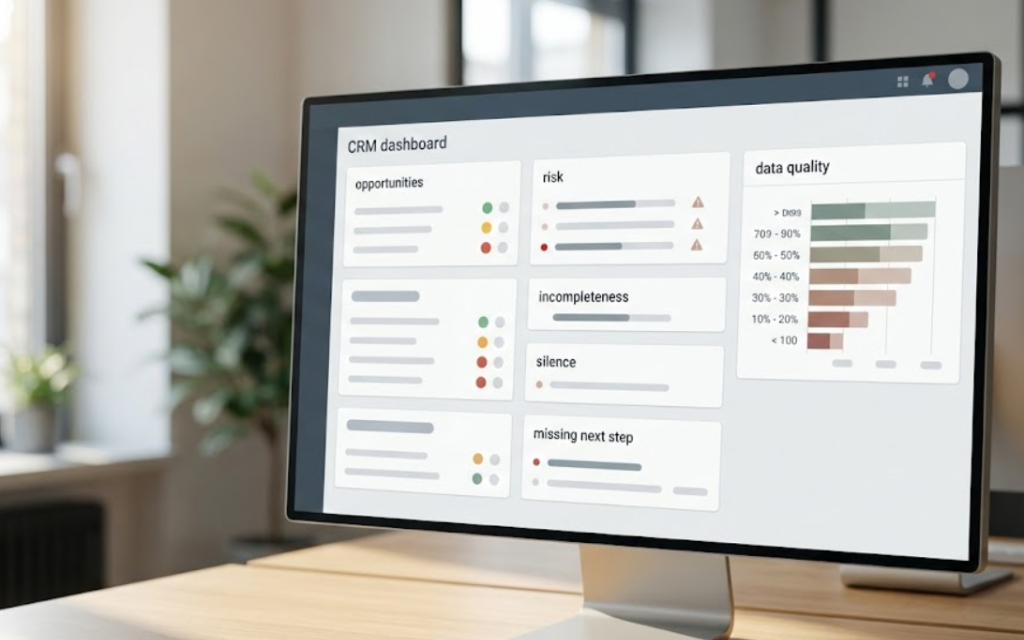
- Can we trust the dashboard data in real time, or do we have to wait for "someone to update it"?
-
- How much time does your qualified team spend moving data from one place to another?
## It is Not an IT Problem, It is an Operational Model Problem
We tend to delegate this to the IT department: "Connect this with that".
But integration is not (just) connecting APIs. It is defining who owns the master data. It is defining the business rules that cross departments. It is deciding that customer experience is more important than a department's comfort in using "their" favorite tool.
Overcoming fragmentation requires leadership, not just code. It requires saying: "Our operational truth is going to be unique, even if it costs us an adaptation effort".
The prize is a company that flows, responds, and scales. The alternative is to keep running faster and faster to stay in the same place, trapped between browser tabs and spreadsheets.
## Closing
If you feel your team works more to feed the system than to serve the customer, fragmentation is likely costing you more margin than you think.
I can help you audit your tool map and design an information flow that eliminates islands and regains operational control.
Diagnóstico express