
# 5S in practice: margin gets lost while searching
Order isn’t a poster. It’s a system designed so that work doesn’t trip over itself.
I don't see 5S as just "cleaning." I see it as margin.
In workshops and warehouses dealing with custom-made business, a huge part of the cost isn't where we usually look. It's in the invisible:
-
- seconds multiplied by hundreds
-
- micro-stops
-
- tools that don't appear when needed
-
- parts that were "around here somewhere,"
-
- assembly delays because a small consumable is missing
-
- issues caused by confusing similar references
-
- quality dropping because the workstation is overwhelmed.
And when this becomes normalized, the company develops an expensive habit: working based on memory and hunting.
This article isn't a "copy-paste" implementation manual or an audit checklist. You won't find a step-by-step guide or a list to hang on the wall. What you will find are signals, risks, and criteria to know if 5S is protecting you... or if you're just putting on a show.
## The symptom that gives it away: “it’s always been like this”
When 5S doesn't exist, phrases appear that sound innocent but are actually alarms:
-
- “We'll tidy it up later.”
-
- “I know exactly where it is.”
-
- “Don't move it, or I'll lose it.”
-
- “It's just that today is really busy.”
-
- “I'll go find it myself.”
I translate those phrases like this: the system doesn't support the workstation; the person does.
And if the person is the one holding it together, the operation cannot scale.
## 5S isn't about tidying: it's about reducing friction
Friction is the silent tax of operations. It's not invoiced, but it is paid:
-
- in lead times
-
- in quality
-
- in team morale
-
- and in margin.
When an operator loses their train of thought due to interruptions, their performance drops. When the workstation is saturated, the probability of error rises. When there are constant "exceptions," the standard disappears.
I use 5S as a strategic question: how much of your operation depends on people "making do"?
## The most common mistake: confusing 5S with aesthetics
I've seen "pretty" factories that remain inefficient.
Aesthetics are easy: cleaning, painting, arranging. The real problem is different: sustaining order when the day gets complicated.
If your order only exists when there's a visitor or when "there's no work," it's not 5S. It's makeup.
## Where margin is lost (and why nobody adds it up)
Margin is lost through four typical leaks:
### 1) Searching
Tools, consumables, assembly aids, small parts.
### 2) Unnecessary movements
Walking back and forth, "while I'm at it" trips that become routine.
### 3) Confusion errors
Similar references, bins without criteria, gray areas.
### 4) Repeating micro-stops
An adjustment, an improvised cleaning, a missing consumable, a machine "without its attachment."
These leaks seem small, but they accumulate brutally. Moreover, they have a secondary effect: they increase COPQ (cost of poor quality) because errors become much more likely.
## My criterion: useful 5S reduces trivial decisions
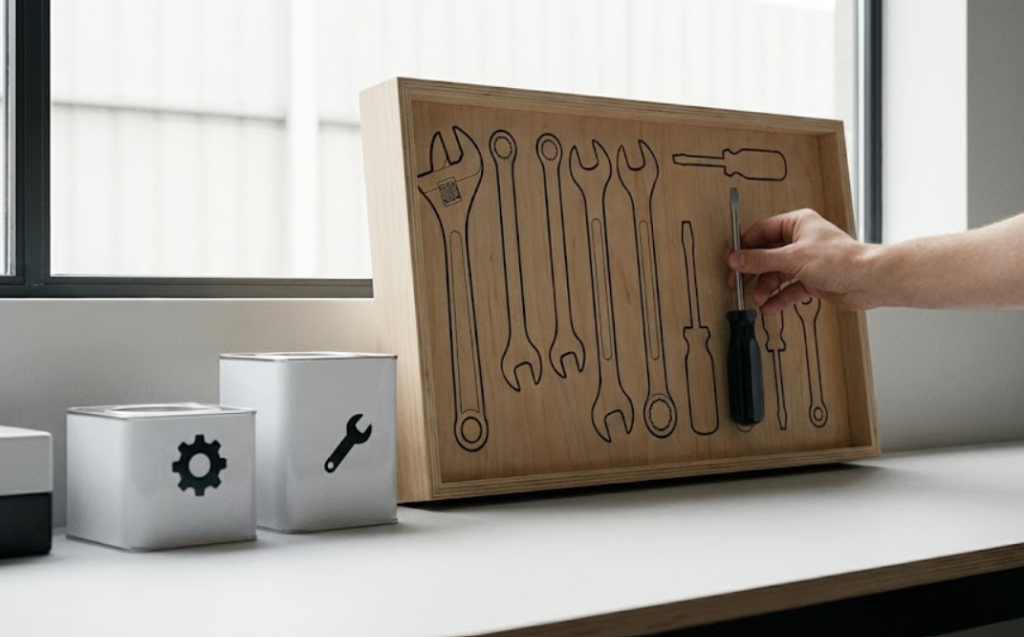
A good workstation eliminates small decisions:
-
- “Where is it?”
-
- “Which one was it?”
-
- “Does this one work?”
-
- “Where do I leave it?”
The more trivial decisions there are, the more attention is drained. And when attention is drained, quality drops.
I want mental energy to be used for what matters:
-
- tolerances
-
- fit and finish
-
- sequences
-
- coordination
-
- and solving real exceptions.
## Signals that your 5S is working (without having to say “we do 5S”)
I don't need to see posters. I need to see evidence:
-
- workstations "explain themselves" (where everything goes is obvious)
-
- the absence of an item "shouts" at you (it doesn't go unnoticed)
-
- critical consumables don't disappear into the chaos
-
- people don't guard their zone like a private territory
-
- and order survives a bad day.
The ultimate test isn't a quiet Monday. It's a Thursday with urgent deadlines.
## The hidden risk: 5S turned into control (then it dies)
If 5S is experienced as:
-
- inspection
-
- scolding
-
- or "the order police,"
people learn to hide things, not to sustain them.
I need 5S to be interpreted as:
-
- execution safety
-
- stress reduction
-
- and quality protection.
If it becomes a culture war, it dies even if the implementation is "perfect."
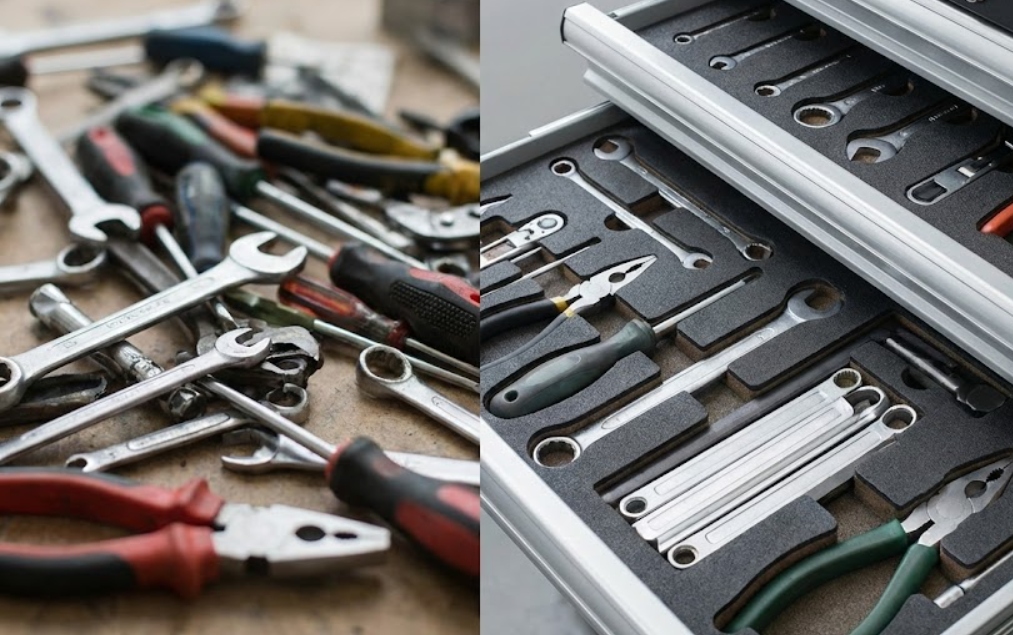
## Real trade-offs: order vs. flexibility
In custom-made businesses, there is a legitimate debate:
-
- “If I standardize too much, I lose flexibility.”
I agree... if you confuse standard with rigidity.
A useful standard doesn't eliminate flexibility. It frames it:
-
- it defines the "floor" on which you can improvise without breaking everything
-
- it creates a common language
-
- and it reduces the cost of changing.
The problem isn't flexibility. The problem is flexibility without a floor.
## Diagnostic questions I use before touching anything
These questions reveal if 5S would give you a return (without needing to dive into tools):
-
- What part of the day is spent searching and "resetting" the workstation?
-
- What errors appear when there's a rush?
-
- Which critical consumable runs out without warning?
-
- Which zones generate ownership conflicts (“don't touch my stuff”)?
-
- Which tasks depend on a specific person because "only they know how"?
-
- What happens when someone is absent? Does the workstation keep humming or does it collapse?
If your answer is "it depends on who's there," your problem isn't productivity: it's system.
## What I do NOT recommend (because it's usually expensive)
-
- Turning 5S into a cleaning campaign.
-
- Tidying up for the photo and returning to chaos the next day.
-
- Designing the workstation without listening to the person working in it.
-
- Doing 5S "from the top down" as a moral discipline.
-
- Measuring order with bureaucracy and killing the meaning.
It's not that it "doesn't work." It's that it becomes an image project.
## Closing
I define 5S like this: a system that prevents margin from being lost while searching.
Not for the sake of cleaning, but for fluidity. Not for aesthetics, but for attention. Not for control, but for operational sustainability.
If you want, I can help you diagnose where your margin is leaking through friction (searching, micro-stops, errors) and what level of 5S would make sense for your operation without turning it into bureaucracy.