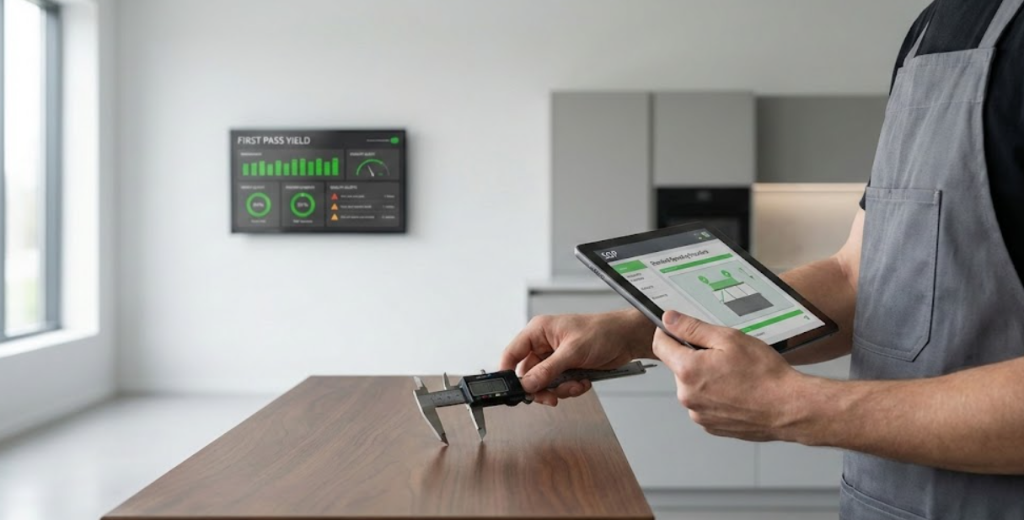
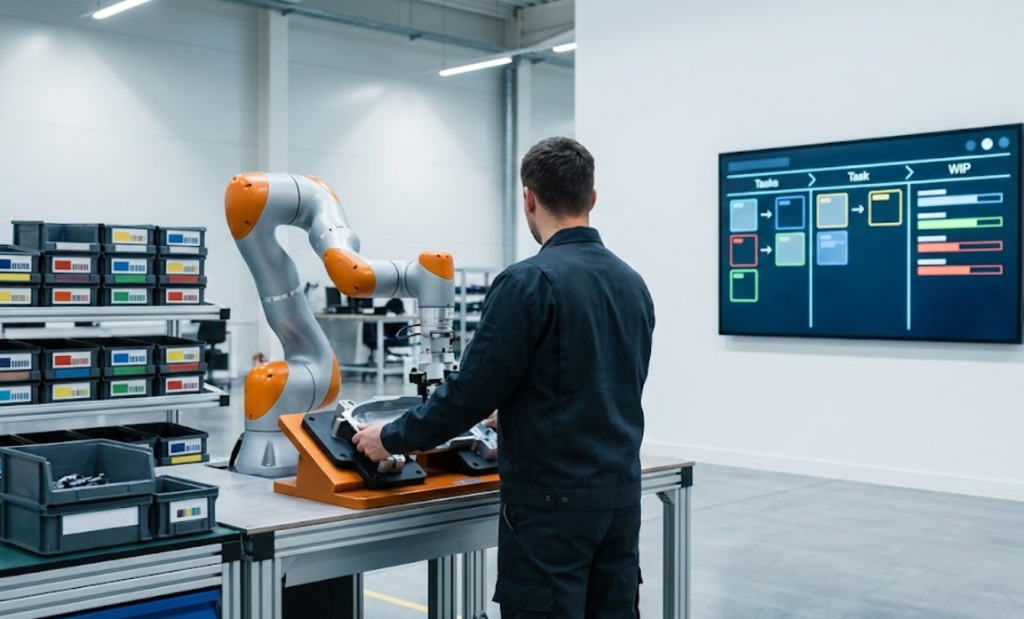

In many furniture workshops and technical offices, the limit is reached when:
-
- demand goes up
-
- the catalog grows
-
- project variability increases
-
- and the team can no longer compensate for the system by simply "pushing harder."
This is the moment when many seek a "technical miracles." But the reality is that a robot can:
-
- multiply your stability if the process is prepared
-
- or automate your chaos if the process is broken.
### The Cobot: A Different Tool for the SME
Collaborative robots (cobots) have broken the entry barrier for small companies. They:
-
- require fewer physical barriers in some scenarios
-
- adapt better to small spaces
-
- and are more accessible for assistance tasks.
However, the "collaboration" isn't just about safety sensors; it's about the process. Because:
-
- if there is no jigging, the cobot hesitates
-
- if there is no standard, the cobot repeats mistakes
-
- if there is no input quality, the cobot amplifies variation
-
- and if there is no well-designed safety, the risk becomes serious.
## Why Automate? The ROI Beyond the Arm
I don't help companies buy robots; I help them buy results. And for that, we need to focus on:
-
- capacity: producing more without increasing shifts.
-
- lead time: reducing queues at a critical station.
-
- quality: reducing human variability in repetitive tasks.
-
- resilience: depending less on profiles that are difficult to fill.
Where does it make sense in a furniture SME?
-
- repetitive pick & place handling and positioning
-
- torque-controlled fastening
-
- gluing or controlled application (when variability is low)
-
- sanding or finishing in very defined operations
-
- machine tending (if the part and flow allow)
-
- repetitive packing and palletizing
-
- and presence/shape control with vision when the criteria are clear.
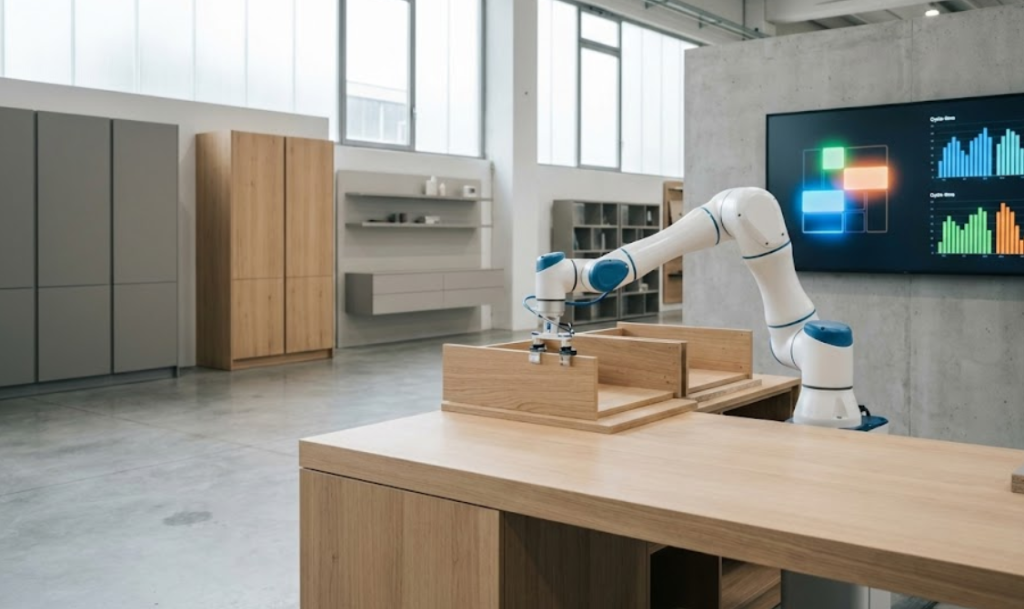
For any of these to work, we need repeatability:
-
- stable input (consistent parts)
-
- defined output criteria (what is "good")
-
- and a repeatable rhythm (so the robot doesn't live in exceptions).
### "It works in my head, but not in the shop"
When someone tells me that automation "is not for us because we are different," I don't take it as a justification. I take it as a symptom.
Because it might be true... but only if a minimum system doesn't exist yet:
-
- clear references
-
- consistent instructions
-
- change control
-
- and flow.
If not, the robot becomes the new place where reality gets stuck.
## My Diagnosis: 10 Signs Your Process is Ready (or almost)
I use simple signs. Not perfect, but honest.
### Readiness Signs
-
- The task has a standard: two people would do it almost the same.
-
- The defect is defined: it doesn't depend on an "expert eye."
-
- Part variation is controlled: reasonable measurements and tolerances.
-
- Input flow is stable: things don't arrive "whenever they can."
-
- Exceptions are few and classifiable: they are not infinite.
-
- Tooling exists or is feasible: fixtures, references, supports.
-
- Safety is designed, not improvised.
-
- There is a responsible person for the cell (not "maintenance will see it").
-
- The station is a real bottleneck or pain point (not a whim).
-
- You can measure before and after: cycle time, defects, stops, queue.
If these signs don't appear, I don't say "don't robotize." I say:
first make the process automatable.
## The Point Almost No One Calculates Correctly: The Robot Doesn't Work Alone with One Arm
In the numbers, people usually count:
-
- robot cost
-
- and hours saved.

But they forget the most real parts:
-
- tooling design
-
- integration with tools
-
- programming and adjustments
-
- training
-
- maintenance and spare parts
-
- and the cost of downtime due to learning.
In other words: you don't buy an arm. You buy a system.
And the ROI doesn't just depend on "how many hours." It depends on:
-
- how much it reduces the queue
-
- how much it reduces rework
-
- how much it stabilizes the lead time
-
- and how much it lowers urgency.
A robot can "pay" in margin without anyone seeing it in hours... if it reduces second visits, claims, or failed deliveries.

## The Simulation that Separates Illusion from Decision
When there is no clarity, I ask a brutally practical question:
what happens to your lead time if this station improves by 20%?
If the answer is "nothing, because the bottleneck is elsewhere," automating there is just aesthetics.
That's why I'm more interested in system capacity than local speed.
In an ideal world, I compare scenarios:
-
- without robot
-
- with robot
-
- with robot + minimal flow changes
-
- and with a prioritization redesign.
And I look for the same result: less queue and more predictability.
## Common Pitfalls When Robotizing in SMEs
I always see the same pattern of errors:
-
- Automating a task that changes every week
If the catalog changes without control, the robot won't pay for itself: it's constantly being reprogrammed.
- 2. Buying "technology" without an operational owner
If there is no clear person responsible for the cell, the cell degrades.
- 3. Underestimating tooling
A cobot without fixtures and references is a fragile promise.
- 4. Measuring only productivity and forgetting quality and queue
If parts/hour go up but urgency doesn't go down, you haven't solved the problem.
- 5. Not designing exception management
Reality lives in the exception. If the robot doesn't know what to do, it stops. And if it stops, it sends the whole system into urgency.
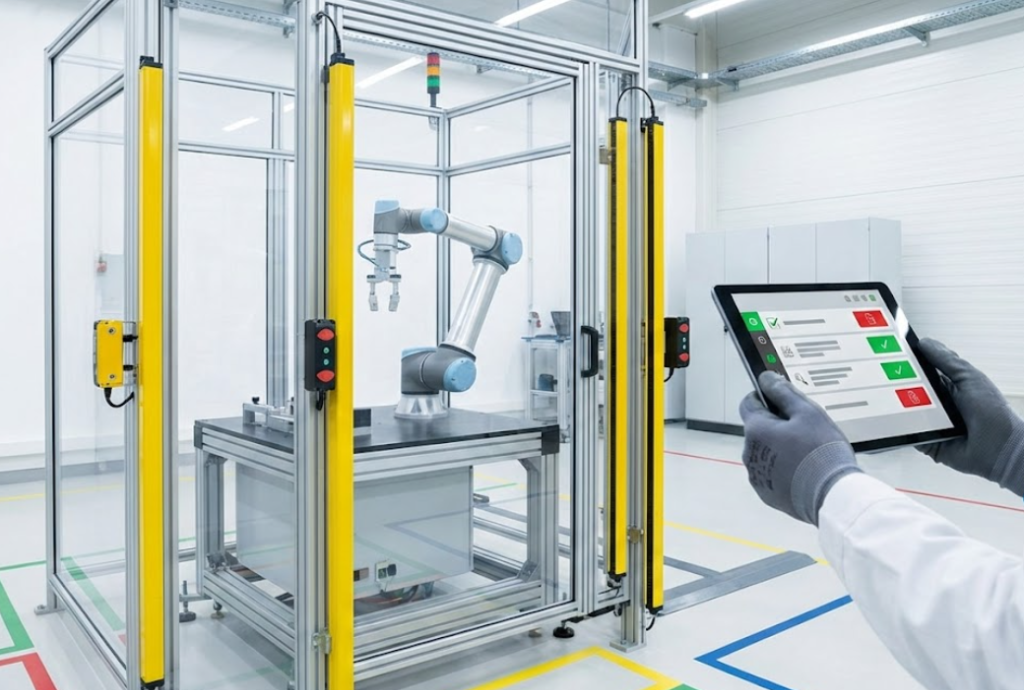
- 6. Treating safety as a formality
Safety is not just a piece of paper. It's part of the design. When improvised, adoption turns into fear.
## Robotization and People: The Point that Decides Sustainability
In most SMEs, the fear is not the robot. The fear is the change:
"will it replace me?", "will I be blamed when it fails?", "will everything be more rigid now?".
That's why I don't treat it as an "engineering project." I treat it as an operation and adoption project.
It shows when:
-
- it's defined which tasks it frees up and which tasks it creates
-
- it's clarified who decides priorities
-
- early learning is protected
-
- and turning errors into blame is avoided.
If people hide problems to avoid looking bad, the robot becomes blind.
## When Do I Say "Yes, Robotizing Makes Sense"?
I say it makes sense when three things are met:
-
- There is real, repeatable pain (queue, lead time, rework, labor shortage).
-
- The task is stabilizable (standard, tooling, quality criteria).
-
- The improvement moves the system (impacts the promise, not just one station).
And I say it's especially interesting when the company:
-
- can no longer grow with overtime
-
- needs to lower urgency
-
- and wants to turn tacit experience into a standard.
## Closing: Automating is a Design Decision, Not a Catalog Choice
Robotization and cobots can be a leap in maturity... if you buy what you truly need: predictability.
If you want, I can look at it with you in 15 minutes: I'll identify the candidate task with you, tell you if it's ready or what it's missing, and give you clear criteria to decide without fantasizing or getting stuck.