
# Psychological safety on the shop floor and on site: the KPI nobody tracks
When people can’t say “this won’t work,” the system screams later through rework, incidents, and broken promises.

I’ve seen a kind of “good atmosphere” I don’t trust: everyone smiles, nobody argues, meetings are calm… and yet defects repeat, timelines slip, and problems show up late.
That calm often has a hidden price: silence.
When people don’t feel safe to speak up (fear of blame, fear of looking incompetent, fear of being ignored, fear of getting extra work), the company loses its nervous system. Early signals disappear.
And in operations, losing early signals is expensive.
This is not a full culture program. My focus is practical: how I detect low psychological safety in plant and on site, what symptoms appear first, and which indicators tell you whether the issue is real.
## What it is (and what it isn’t)
For me, psychological safety isn’t “being nice,” “lowering standards,” or “avoiding conflict.”
It’s simple:
The real ability to raise a risk, error, or doubt without paying a social price.
That includes saying:
-
- “I don’t understand.”
-
- “I think this is risky.”
-
- “This doesn’t match the standard.”
-
- “If we continue, we’ll repeat the failure.”
-
- “I need to stop to verify.”
If that sentence can’t be said, learning dies and repetition wins.
## The operational mechanism: why fear breaks quality and lead time
Fear (explicit or implicit) → silence → problem grows → late discovery → urgent reaction → patch becomes normal → repetition.
Operations has cheap time (early) and expensive time (late). Psychological safety multiplies cheap time.
## Early signs of fear (before KPIs collapse)
### Sign 1: Problems “appear suddenly”
If everything is “out of nowhere,” usually people saw hints but didn’t speak.
### Sign 2: Few questions in public (questions move to private)
If doubts live in corridors and DMs, the system is opaque.

### Sign 3: “Busy” is confused with “healthy”
Firefighting looks like commitment, but it’s often silence in motion.
### Sign 4: Error equals shame
If mistakes mark people, people learn to hide.
### Sign 5: Meetings are theatre
Everyone nods, nobody brings bad news, reality contradicts later.
### Sign 6: Heroes beat prevention
If last-minute rescues earn status, prevention becomes invisible.
## Hard signs (when results are already impacted)
Repeated incidents, rework that won’t drop, late escalations, failures jumping across stages, timelines held by urgency, emotional fatigue and turnover in critical roles.
## The KPI nobody tracks: escalation latency
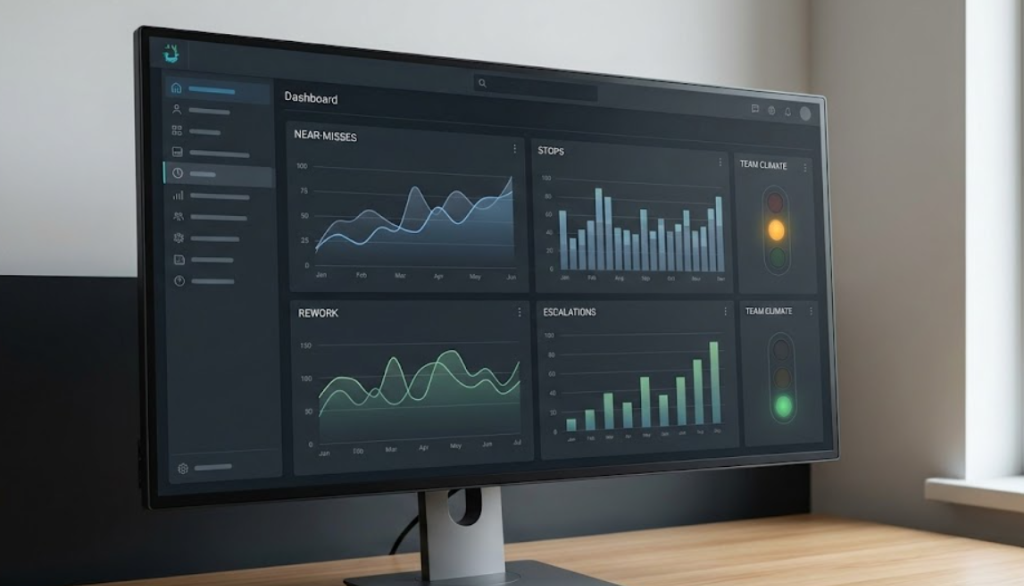
If you force me to pick one KPI to start with:
Escalation latency = time between “someone notices a signal” and “the system acts on it.”
In fear cultures, latency explodes: people wait to not bother, to not look bad, to not become “the difficult one.”
You don’t need perfection—just honesty: when was it first noticed, and when did action begin?
## On-site reality: safety is paid in extra visits
On site, uncertainty is higher and dependencies are tighter. Low psychological safety produces patterns:
-
- nobody confirms critical measurements
-
- conditions are assumed
-
- people improvise to avoid stopping
-
- issues are hidden “to see if it can be fixed.”
That becomes second visits, ad-hoc adjustments, inter-team conflict, wrong prep and wrong orders.
## Proxy indicators (behavior beats speeches)
You can measure system behavior without turning it into therapy:
1) Near-miss reporting (and its quality)
2) Ratio of preventive stops vs disaster stops
3) “Surprise rework”
4) Red signals with no owner
5) Public questions vs private questions
6) Handover quality (ability to say “this isn’t closed”)
## Language cues I listen for
-
- “I don’t want trouble, but…”
-
- “We’ve always done it this way.”
-
- “Better not say it.”
-
- “We’ll see later.”
-
- “No time for that.”
-
- “If I say it, it lands on me.”
These are not “bad people.” It’s a system trained to avoid the social cost of speaking.
## Anti-patterns that destroy safety (even with good intentions)
1) “Why?” as interrogation
2) Demanding a solution from the messenger
3) Public ridicule
4) Confusing calm with health
5) Punishing errors while standards are ambiguous
## The micro pulse that actually helps
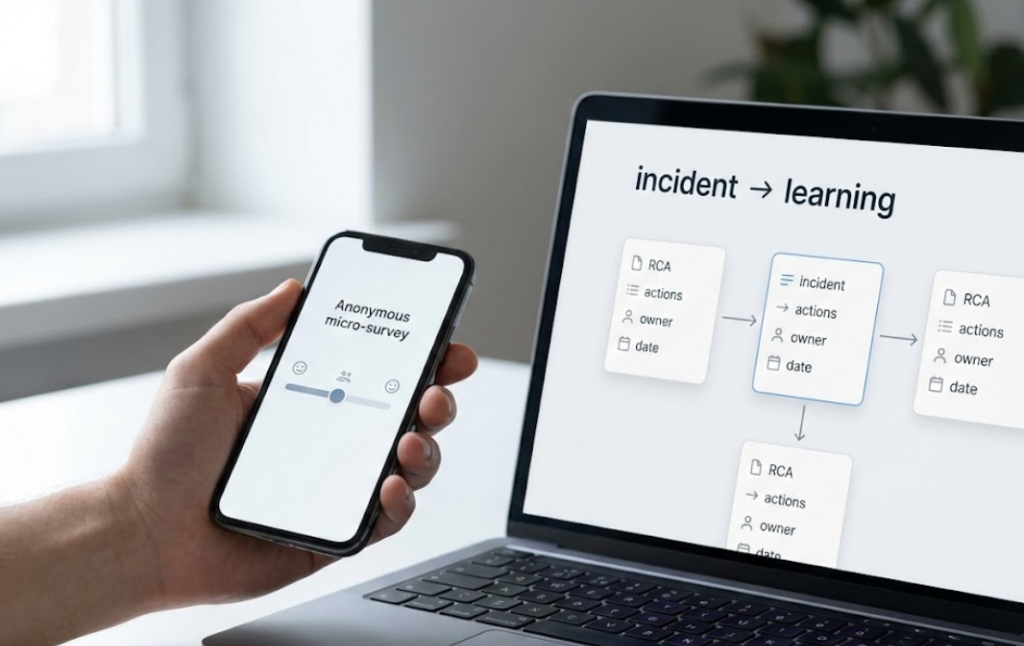
Pulse surveys can work if they’re:
-
- short (2–4 items)
-
- anonymous
-
- repeatable
-
- operational (not therapy)
-
- visibly acted upon.
The number isn’t the goal. The trend and coherence with reality is.
## Diagnostic questions I’d ask first
-
- What did people “see coming” but escalated late?
-
- What topic is avoided in meetings?
-
- Where does recurrent rework live—and who absorbs it?
-
- Which near-miss is never reported?
-
- Where do people improvise because there’s no standard?
-
- Where do escalations stop and improvisation begins?
-
- Which role pays the social price of speaking?
## What changes when psychological safety rises
1) Problems show up earlier (not more problems—less hiding)
2) Cost per incident drops (less sunk cost)
3) Learning becomes routine: signal → treatment → action → verification
At first it may look worse because more signals surface. For me, that’s the nervous system coming back.
## Closing
If you want, I can help you measure and diagnose psychological safety as an operational KPI, find where the signal is being lost across plant/site, and design a minimal escalation-and-learning loop that protects quality, lead time, and margin.