


The question that changes everything: do you work in screens or in decisions?
When a company tells me “we need more software,” I don’t assume they need more screens.
Often the real workflow looks like:
-
someone asks
-
someone confirms
-
someone rewrites
-
someone chases
someone finally “makes it happen”.
That “make it happen” lives in people, not in systems.
Then growth arrives, complexity rises, and your promise (date, margin, experience) starts depending on chasing someone in chat.
That’s where agent-first belongs.
## What agent-first means (without hype)
Agent-first is not “a chatbot on top of ERP.”
To me it means:
- software stops being forms
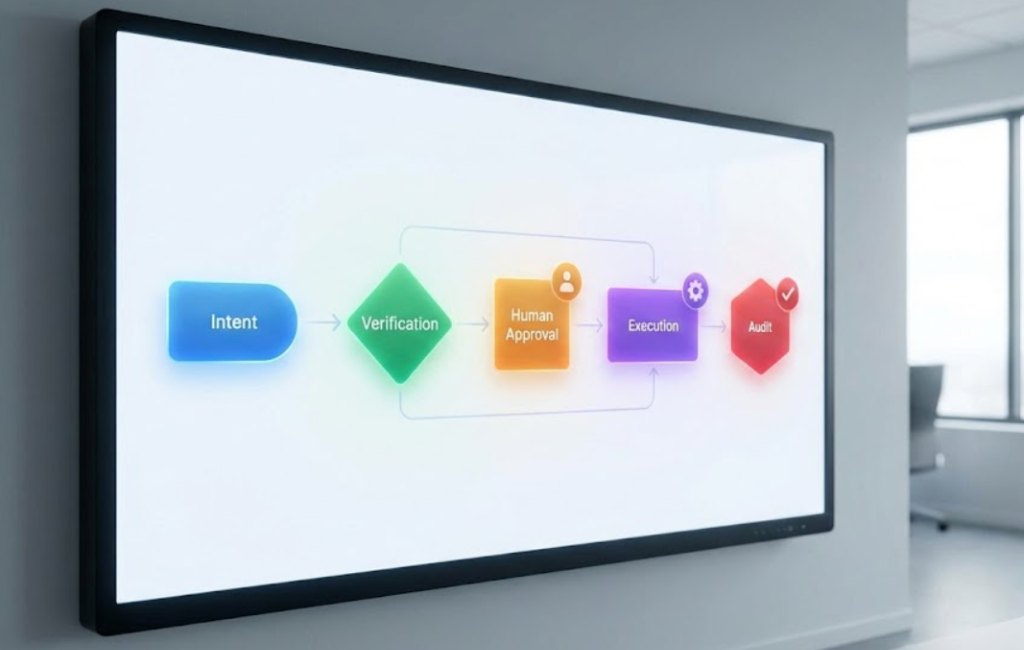
and becomes a system that understands intent, verifies conditions, requests approvals, and executes actions inside rules.
App-first: users move the process by clicking. Agent-first: users state intent and the system coordinates the movement.
That shift is operationally huge.
## Why it’s showing up now (and why it can get expensive)
Because we can now automate flows, integrate systems, and use AI to interpret language and context.
It gets expensive when treated as a shortcut: “add an agent and done.”
If definitions, permissions, and data truth are weak, autonomy doesn’t fix you. It multiplies your current state.

## The maturity signal: how much work exists just to coordinate
I look for heavy time spent on: chasing confirmations, asking for status, translating chats into orders, reconciling versions, fighting data conflicts.
That effort keeps continuity—but it burns teams. Agent-first aims to convert manual continuity into system continuity.
## The mental model: intent → conditions → action → evidence
Intent: “promise a date”, “approve a change”, “release an order”.
Conditions: approvals, completeness, capacity, margin thresholds, data consistency.
Action: controlled execution across systems.
Evidence: audit trail of who decided what, when, and why.
## What agent-first should NOT do
invent states
act without explicit permissions
hide uncertainty
execute irreversible changes without approval
become a black box
A good agent-first approach is more auditable than manual work.
## The big risk: agents everywhere, truth nowhere
Easy agents create fragmentation: multiple “decision centers” with different interpretations.
I prefer a boring, profitable principle:
one truth for critical data, and agents that obey it.
## The line between “system” and “toy”: governance
My first question is not “what does it do?”
It’s: what can it touch, with what permissions, and how is it audited?
Healthy governance has roles, thresholds, traceability, safe mode, and reversibility. Risky governance relies on “we’ll fix it if it breaks.”
## Where I typically see fast value
defensible promising (conditions + evidence)
controlled changes (gates)
completeness and shipping readiness
post-sale memory that triggers actions, not just messages

## How I know you’re ready
Ready signals: shared state language, a workable source of truth, coordination pain, leadership that wants traceability.
Not-ready signals: conflicting state meanings, “we solve it by talking,” no data ownership, or a desire for full autonomy from day one.
## Decision questions I’d ask before spending
what decision to accelerate—and what to protect?
what data must be unique?
what actions are allowed without approval, and which never?
what approval thresholds exist?
what evidence is required to pass a gate?
how will we measure improvement?
## Closing
Agent-first isn’t about “AI that talks.” It’s about reliability: protecting the promise, reducing friction, and leaving evidence.
If you want, I’ll review it with you in 15 minutes: which decisions fit an agent-first approach, what minimum conditions are missing, and what criteria keep it safe.
Diagnóstico express