
# Dynamic safety stock: protect service without trapping cash
A buffer that adjusts with evidence… or an expensive excuse to avoid the real issue.

I hear this all the time: “We need stock, otherwise we’re exposed.”
The intention is right. The problem starts when that “cushion” becomes a habit: it grows, nobody questions it—and stockouts still happen. Then the most dangerous double symptom shows up, because it feels impossible and yet it’s common:
-
- the critical items are missing (and execution breaks)
-
- the irrelevant items pile up (and cash gets trapped).
When shortages and excess coexist, inventory stops being a tool and becomes noise: it hides the truth, delays decisions, and increases the silent cost of managing urgency.
This is not a step-by-step guide to “calculate the perfect stock.” That doesn’t exist in real operations. This is about something more useful: how to tell whether your safety stock is governed (and truly protects service) or whether it’s a costly patch that covers disorder.
Full implementation—rules, segmentation, cadence, ownership, automation—belongs in a tailored diagnosis. What works depends on your product, your delivery model, and how your demand behaves.
## The core mistake: treating safety stock like a fixed number
Many companies define safety stock as a static figure: “X units,” “Y days,” “Z by family.”
That only works when the world is stable.
In real businesses (projects, customization, variable lead times, non-clockwork suppliers), risk is not constant. It changes with:
-
- demand variability
-
- real lead times
-
- supplier reliability
-
- project mix
-
- internal capacity
-
- how early you detect exceptions.
That’s why I talk about dynamic safety stock: not as “AI hype,” but as a simple idea:
The buffer should adjust when risk changes.
If risk rises and the buffer stays fixed, you lose service. If risk drops and the buffer stays fixed, you trap cash.
## What safety stock is quietly compensating for
When I audit inventories, I rarely find “strategic excess.” I find excess built from anxiety.
Safety stock often compensates for what the system isn’t solving:
-
- lead times that drift without warning
-
- consumption that isn’t recorded reliably
-
- improvised substitutions
-
- inconsistent product data
-
- late purchasing reactions
-
- priorities that change daily
-
- lack of clarity on what is truly critical.
Increasing safety stock without governance buys “peace”… and buys opacity. And opacity is expensive.
## Signals your cushion has become a bet

If these feel normal, your safety stock is likely not governed:
### 1) The warehouse is “full,” but the team lives in urgency
The issue isn’t “too little inventory.” It’s the wrong inventory, in the wrong place, at the wrong time.
### 2) Replenishment is driven by intuition (or by the last fire)
If replenishment depends on “what happened last week,” you’re driving while looking only in the rear-view mirror.
### 3) “Theoretical” lead times don’t resemble real lead times
If lead time moves and the system doesn’t learn, the buffer becomes a lottery.
### 4) Critical isn’t explicit (everything becomes “urgent”)
If everything is critical, nothing is. A buffer needs hierarchy, not shouting.
### 5) People skip consumption recording “to save time”
When data is optional, replenishment becomes opinion.
### 6) Stockouts “nobody saw coming” (but later “it was obvious”)
If after the failure everyone can explain why it happened, you had the signal—you just weren’t seeing it early enough.
## Dynamic doesn’t mean complex: it means governed
“Dynamic” is not a synonym for “advanced math” or “expensive software.”
It means three things:
-
- risk is measured (even by ranges)
-
- buffers adjust when risk changes
- ownership is clear.
The difference between a warehouse that protects the promise and one that traps cash is not the number. It’s governance.
## The triangle nobody wants to name: service, cash, stability
Inventory is trade-offs. You don’t get maximum service, free cash, and zero uncertainty at the same time.
So when someone asks me to “optimize inventory,” I translate it into a more honest question:
-
- what service level are you willing to defend for critical items?
-
- how much cash are you willing to immobilize for it?
-
- how much volatility in lead time and mix are you willing to tolerate?
If these are not explicit, safety stock becomes an emotional debate: “buy more” vs “buy less.”
I prefer an operational one: what risk are we covering and why.
## What usually breaks the model (quietly)
Five common reasons a well-meant buffer fails:
### A) Confusing variability with growth
### B) Measuring “nice” consumption instead of real consumption
### C) Not separating critical from convenient
### D) Not capturing real lead-time variability
### E) Not having an exception system
Without exceptions, the company reacts late—and reacts expensively.

## The turning point: stop talking about “inventory,” start talking about “buffers”
Mature teams stop seeing stock as “stored stuff” and start seeing a set of buffers:
-
- buffer to protect service for criticals
-
- buffer to absorb lead-time variability
-
- buffer to absorb consumption variability
-
- buffer to decouple internal constraints.
Not every buffer is equal. Not every buffer deserves to exist.
This shift forces the key question: “What risk am I buying with this stock?”
## Cadence: the difference between control and superstition
A strong maturity signal is not the tool—it’s the cadence.
When safety stock is governed, there’s a short recurring routine to review:
-
- what changed in risk
-
- which items entered exception zones
-
- which stockouts were close
-
- which excess is growing without value
-
- which decisions lack an owner.
Without cadence, buffers get touched only when there is pain. That’s late.
## “What if I adjust wrong?” — the fear that freezes improvement
Teams avoid changing safety stock because “if we mess up, we’ll break delivery.”
That fear is rational… when you don’t have early signals.
The adult way to manage the risk is not to trap cash “just in case,” but to build:
-
- early detection (see risk before stockout)
-
- clear priority (know what to save first)
-
- fast action (accelerate decisions in exceptions).
When that exists, the system can tolerate adjustments. When it doesn’t, inventory becomes an expensive sedative.
## The dashboard I want (and what I don’t want)
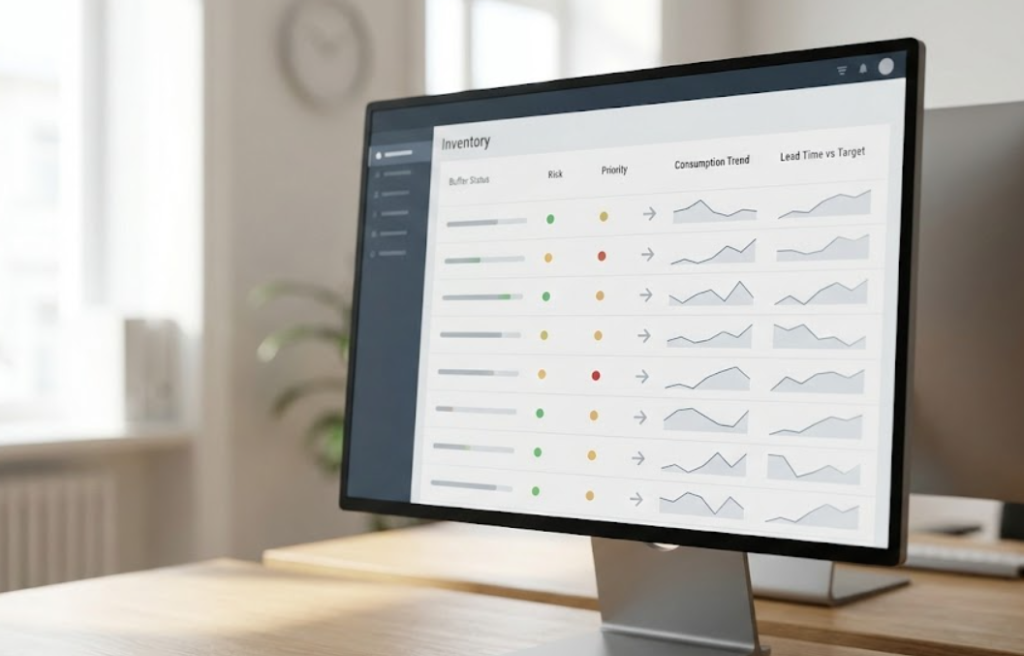
I don’t need pretty screens. I need useful answers.
I want to see:
-
- which items are at risk (by criticality)
-
- which items are in excess with rising trend
-
- which real lead times are deteriorating
-
- which consumptions are becoming erratic
-
- which decisions have no owner.
I don’t want:
-
- total stock as a trophy
-
- averages without context
-
- late indicators
-
- endless lists without priority.
## The pattern that destroys margin: urgency + substitution + silence
A common pattern in configurable/project businesses:
- A critical item is missing.
2) People substitute “what’s available.”
- Workshop/site improvises.
- It’s recorded poorly.
- The system learns the wrong pattern.
- Next project fails again.
This isn’t a warehouse problem. It’s a system problem.
Governed dynamic buffers cut this chain by forcing:
-
- explicit criticality
-
- governed substitution
-
- exception ownership
-
- non-optional data.
## Diagnostic questions I ask before proposing anything
-
- How many “near stockouts” happen weekly without being documented?
-
- What is critical by promise (not by habit)?
-
- How variable are real lead times (not the promised figure)?
-
- What portion of consumption isn’t recorded with discipline?
-
- What share of replenishment is urgency-driven?
-
- Which excess grows by inertia without explicit criteria?
-
- Who can change a buffer—and under what conditions?
-
- What signals warn you before the fire starts?
If these answers are unclear, “optimization” becomes theatre: numbers change, behavior doesn’t.
## Fast checklist
-
- Critical is defined (by promise).
-
- I see real lead-time variability.
-
- I have a short exception list with priority.
-
- Substitutions are governed.
-
- Consumption data is reliable enough.
-
- There is a brief risk/buffer cadence.
-
- Buffers have an owner (not shouting).
-
- I can explain buffer changes without emotion.
Fail 3+ and the cushion is likely a bet.
## Closing
If you want, I can help you determine whether your safety stock is protecting service or trapping cash, and what minimum signals you need to govern it without improvisation.
I won’t sell you a “formula.” I’ll help you build a system that makes decisions with evidence and priority.